
Family
Family counseling online,
when the pattern involves more than two people
Parent and adult-child conflict, joint-family pressure and arguments that pull in the whole household. Participants and fee are agreed before booking.
- Format
- Online, by arrangement
- Who attends
- Agreed in advance
- First call
- 10 minutes, free
- Languages
- English · Urdu · Punjabi
Family counseling at The Bonding Corner looks at repeated patterns between family members rather than one person’s problem. Sessions are held online with psychologist Zahid Sohail in English, Urdu or Punjabi. Participants, session length and the fee for a family session are arranged before booking, starting with a free 10-minute call.
The idea
What is family counseling?
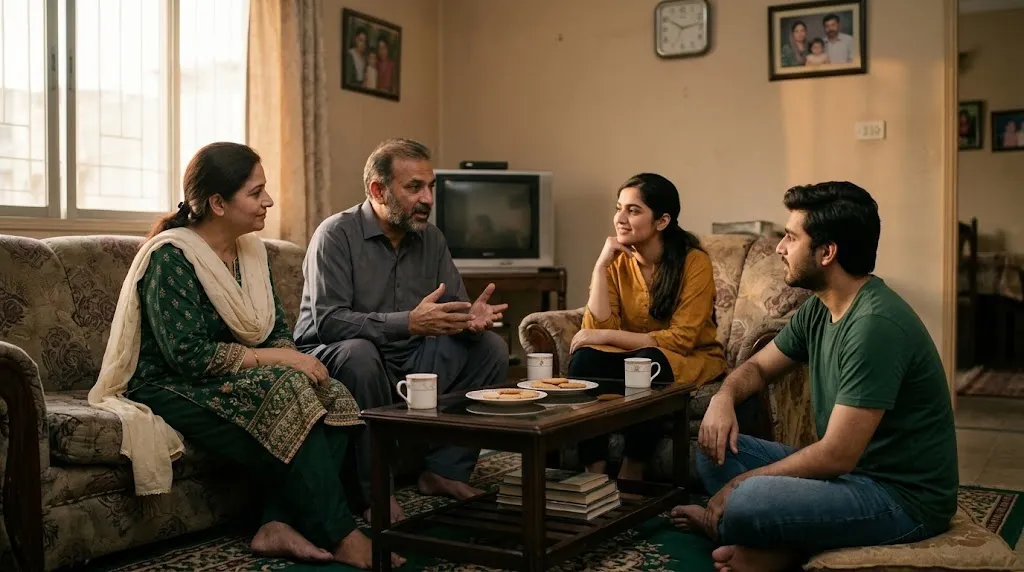
Family counseling treats the pattern between people as the subject, rather than treating one family member as the problem. The question moves from who is difficult to what happens between you all, and what keeps it happening.
In practice that means tracking a specific recurring situation through each person’s account of it, then looking at where it could be interrupted.
What it is not
A family session is not a hearing and it does not appoint a winner.
- No one is diagnosed on someone else’s account.
- Nothing is reported back to the family member who booked it.
- The counselor does not take instructions from one side.
- Children and adolescents are only seen where the practice’s age and consent policy allows it.
Who comes
Who attends a family session?
It depends entirely on the concern and on who is willing. All of these are workable starting points.
One person, on their own
Often the person who notices the pattern first. An individual session can still change how you respond to it.
Individual counselingTwo family members
A parent and an adult child, two siblings, or a couple dealing with pressure from the wider family.
Parents together
Where the disagreement is between parents about how to handle a child’s behaviour or future.
Parenting counselingA wider group
Larger sessions are arranged case by case. Numbers, length and fee are agreed before anything is booked.
Typical work
What does a session focus on?
One situation, in detail
A specific recent argument, traced through what each person did and expected, is more useful than a general complaint.
Roles that stopped fitting
The responsible one, the difficult one, the one who keeps the peace. Roles set years ago rarely update themselves.
Boundaries in a shared home
Privacy, money, decisions and space, where several adults live under one roof.
What each person can change
The session ends with something each attending person can actually do, not with an instruction for someone absent.
When family counseling is not the right step
A joint session needs a minimum of goodwill in the room. Where that is absent, individual work or a different service is more useful.
- Where someone in the household is being hurt, controlled or threatened.
- Where a family member is being brought under pressure rather than by choice.
- Where the purpose is to have an outsider confirm one person’s account.
- Where a child or adolescent needs their own assessment and referral.
An individual session is a legitimate way to start when the rest of the family will not attend.
Who wrote this
Written by Zahid Sohail
Psychologist and founder of The Bonding Corner. MSc and PGD in Applied Psychology, more than 15 years in practice, working in English, Urdu and Punjabi.
Last reviewed:
This page is general information, not a diagnosis, and counseling does not replace medical care. About Zahid Sohail · Mental health words in Urdu
What the research says
- A review of a decade of research found couple therapy helped around 70% of couples who received it, with results comparable to individual therapy. [1]
- WHO guidelines recommend parenting support to strengthen the parent-child relationship, reduce harsh parenting and lower parents' own stress. [2]
- Talking therapies involve speaking with a trained professional about your thoughts, feelings and behaviour, and are used for a wide range of difficulties. [3]
References
[1] Lebow JL, Chambers AL, Christensen A, Johnson SM. Research on the treatment of couple distress. Journal of Marital and Family Therapy, 2012. europepmc.org
[2] World Health Organization. WHO guidelines on parenting interventions to prevent maltreatment and enhance parent-child relationships (2023). www.who.int
[3] NHS. Talking therapies (reviewed 5 November 2025). www.nhs.uk
If you are thinking about ending your life or are in danger now, call Rescue 1122 or Police 15, or Umang’s 24-hour helpline on 0311 7786264. Online counseling is not an emergency service. All helplines in Pakistan.
Questions, answered
Questions people ask.
How does family counselling work?
Family counseling treats a repeated pattern between family members as the subject, rather than one person being the problem. Who attends, the session length and the fee are agreed before booking.
What are the different types of family counseling?
Family work ranges from whole-family sessions to parent-only sessions, sibling or in-law focused sessions, and individual sessions about a family situation. The right format depends on who is willing to attend.
Who should attend a family counseling session?
Whoever is part of the pattern being discussed, which is not always the whole household. Who attends can change between sessions, and that is discussed rather than fixed at the start.
How much does family counseling cost?
Family sessions are booked at the couple rate of Rs. 3,000 for 90 minutes. The free 10-minute introductory call is available first if you want to check that this is the right format.
Can family counseling work if one person refuses to come?
Often yes. One person changing how they respond can shift a pattern that involves several people. Work with whoever is willing rather than waiting for everyone to agree.
Explore further
Where would you like to go next?
Someone in the family usually asks first.
Starting the conversation on your own, before anyone else agrees to attend, is a normal way in.