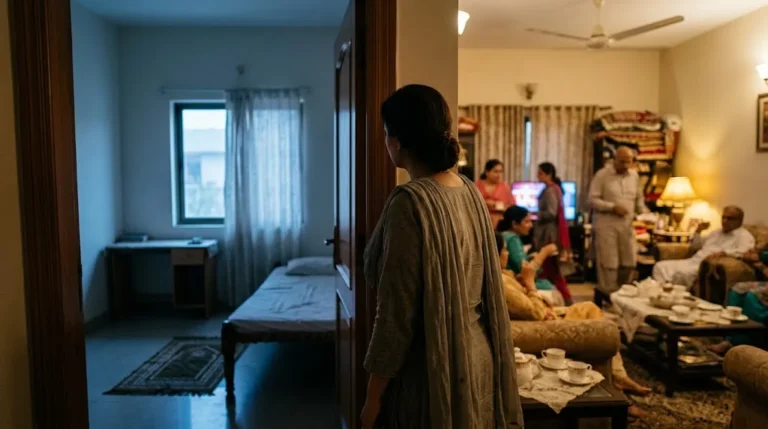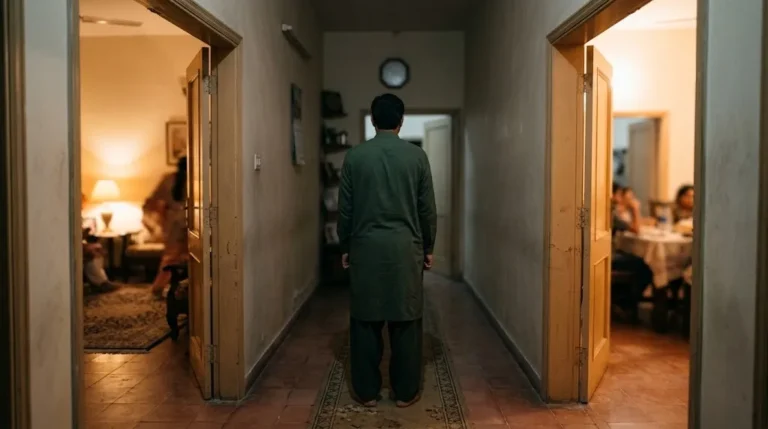
Parents who compare you to everyone else’s children

Short answer
Being repeatedly compared to other children teaches a person to evaluate themselves against external standards rather than their own, which continues long after they leave home. It is usually intended as motivation and rarely works as one, because shame reduces effort more often than it increases it.
“Look at your cousin.” “Your friend’s son got into NUST.” “At your age I had a house.” “Your sister never gave us this trouble.”
Almost every Pakistani adult has a version of this stored word for word, often from twenty years ago, and can still recite it. That is worth noticing on its own. Ordinary parental remarks do not usually survive two decades intact.
What it does
It installs an external measure
A child compared often enough stops developing their own sense of whether something was good. The question “am I doing well” gets permanently outsourced, and the answer depends on who else is in the room. This does not end when you leave the house. It follows people into careers, marriages and parenting, and it is why a great many accomplished adults feel like frauds.
It makes achievement worthless
The comparison moves. You get the grade and the response is about someone who got a better one. After enough repetitions, achieving stops producing satisfaction, because the target has always already shifted. People describe reaching things they worked years for and feeling nothing at all.
It damages the actual relationships
The cousin held up as the standard becomes a person you cannot be close to, through no fault of theirs. Many family estrangements between siblings trace directly back to parents who ranked them.
It teaches performance rather than honesty
A child who is measured learns to manage information. Problems do not get reported, failures get hidden, and a lifetime of presenting an edited version of yourself to your parents begins at about age nine.
Why parents do it
Not because they think poorly of you, in most cases. A few reasons come up repeatedly, and they are worth knowing because they make the behaviour less personal:
- It is the only method they were given. They were raised on it, and it is what they have.
- They believe it motivates. A genuine, mistaken belief that shame produces effort. It sometimes produces short-term compliance, which appears to confirm the theory.
- Their own standing is involved. In a community where children’s outcomes are a public measure of the parents, your result is partly their result, and that is a lot of pressure travelling downwards.
- Fear. Worry about your future with no better vocabulary for it than comparison.
None of this makes it harmless. It does make it something other than a verdict on your worth, which is how it is received.
Undoing it as an adult
Notice the voice and identify it
The comparison eventually stops needing a parent to say it. It becomes internal, and it sounds like your own thinking. Being able to hear “that is my mother’s sentence, not mine” is the first genuine step, and it takes practice.
Build your own measure, deliberately
If your standard has always been someone else, you need a replacement rather than an absence. Concretely: what would make this a good year, by your own account, stated before you find out what anyone else did. Written down, so it cannot be revised afterwards.
Stop supplying information
You are not obliged to report your salary, your appraisal, or your plans to anyone who will convert them into a comparison. This is not deceit. Adults are allowed to keep their own affairs.
Decline the comparison out loud, once, mildly
Not a confrontation about twenty years. Something small, in the moment, repeated calmly: “I am not going to compare myself to Ahmed.” Said without heat, as a statement of what you do rather than an accusation of what they do. It rarely stops them immediately. It does change what you are participating in.
Expect that they may never acknowledge it
This is the part people struggle with most. Many parents are genuinely unable to see it, and waiting for an apology that will not come keeps the wound open. The recovery does not depend on their agreement, which is unfair and is also freeing.
If you have become the parent
The pattern transmits with unusual reliability, and people who hated it are often startled to hear it coming out of their own mouths. Two things help: comparing a child only to their own previous work, and separating the behaviour from the person, so that “this homework was rushed” never becomes “you are careless, unlike your brother”.
Parenting counseling deals with this directly, and wanting to not repeat what was done to you is one of the most common reasons parents come.
Getting help
If the comparison has left you unable to feel that anything you do is enough, that is worth working on rather than living with. Self-esteem and confidence counseling addresses the internal measure directly.
If the relationship with your parents is the live problem rather than its legacy, family counseling is the relevant service, and it does not require them to attend for you to begin.
Common questions
Why do Pakistani parents compare their children to others?
Usually because it is the method they were raised with and because they genuinely believe it motivates. Community standing is also involved, since children’s outcomes are treated as a public measure of the parents, which pushes a great deal of pressure downward.
Does comparison motivate children?
Rarely in any lasting way. It can produce short-term compliance, which makes it look effective, but sustained shame generally reduces effort and damages the child’s ability to judge their own work.
How do I stop comparing myself to others as an adult?
By building a measure of your own and stating it before you learn what anyone else has achieved. The internal comparing voice does not disappear, but learning to recognise it as inherited rather than true changes what you do with it.
Should I confront my parents about it?
A confrontation about twenty years of remarks rarely goes well. Declining a specific comparison calmly in the moment, repeatedly, tends to achieve more and costs less.
What if my parents never admit they did it?
Many will not, and some genuinely cannot see it. Recovery does not require their acknowledgement, which is both unfair and useful to know, because waiting for it keeps the matter permanently open.
How do I avoid doing this to my own children?
Compare a child only to their own earlier work, and keep criticism attached to the specific behaviour rather than to the person. Parenting counseling is often sought for exactly this reason.
Ten minutes is enough to find out whether this helps.
What the research says
- Low self-esteem often starts with messages absorbed in childhood and can be worsened by stressful life events. NHS guidance notes that talking therapies can help. [1]
- WHO guidelines recommend parenting support to strengthen the parent-child relationship, reduce harsh parenting and lower parents' own stress. [2]
Sources
- NHS. Raising low self-esteem (reviewed 11 April 2023). www.nhs.uk
- World Health Organization. WHO guidelines on parenting interventions to prevent maltreatment and enhance parent-child relationships (2023). www.who.int
Last reviewed 29 September 2026. General information, not a diagnosis. In an emergency call Rescue 1122 or Umang’s 24-hour helpline on 0311 7786264. All helplines in Pakistan.