Losing yourself in a joint family

Short answer
Living in a joint family erodes a sense of self when there is no private space, no unobserved time and no decision that is yours alone. The loss is usually gradual and goes unnamed. Recovering some of it does not require leaving; it requires small protected areas of autonomy that are defended consistently.
Nobody in this situation is being mistreated in any way they could point to. That is what makes it so hard to describe, and so hard to get sympathy for.
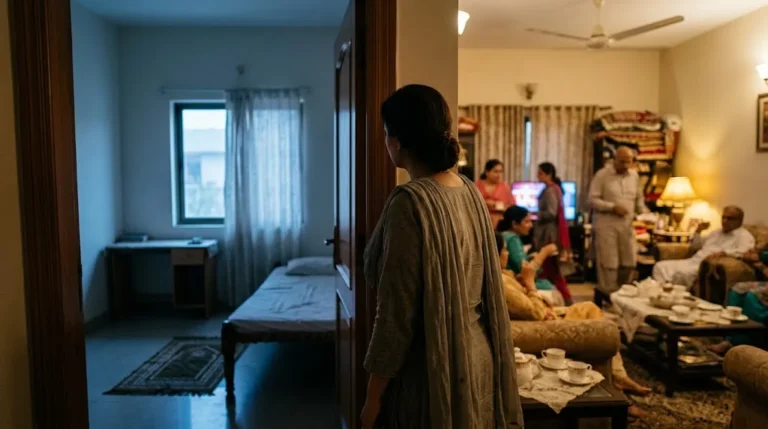
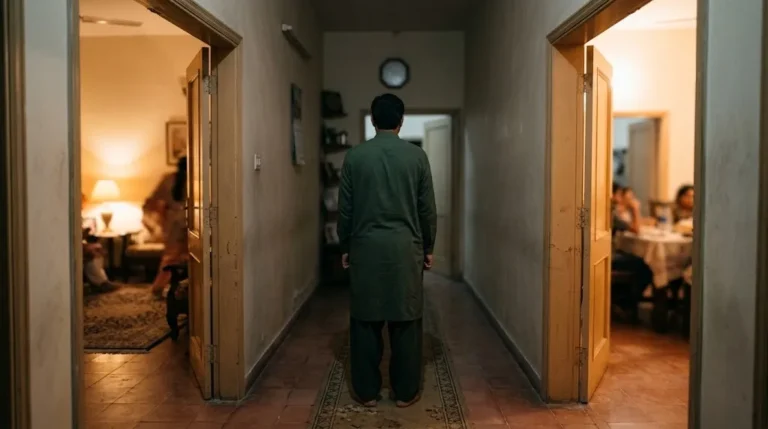
The food is shared and it is good. Everyone is fed, everyone is safe, the children have eight adults who love them. And somewhere in the third or fifth year, a person realises they have not had an hour alone since they moved in, have not made a single decision without consultation, and can no longer say with any confidence what they themselves think about anything.
What is actually being lost
Not freedom in the dramatic sense. Four smaller things:
Physical privacy
One room, which is also the only place to have a difficult conversation, cry, pray alone, or be in a bad mood. If a marriage has no private space, every disagreement is either held in whispers or overheard.
Unobserved time
Time that nobody knows about. In a joint household everyone knows where you are, how long you were there, who you were talking to and what you spent. None of it is sinister and the cumulative effect is that you are never off duty.
Decisions that are yours
From the significant, such as the children’s schooling, down to what to cook on a Tuesday. When every choice is a consultation, the muscle for having a preference weakens, and after a few years people genuinely cannot answer the question “what do you want”.
A self-description that is not a role
Bahu, bhabhi, beta, mother of, wife of. Roles are not a problem until they become the only available vocabulary, and the person under them becomes difficult to locate.
Who this tends to hit hardest
- The daughter-in-law who moved in, who is in the most exposed position by some distance, with the least standing and the most observed behaviour.
- The son in the middle, who is being asked to choose between his mother and his wife several times a week and usually copes by refusing to take any position at all, which satisfies nobody.
- The unmarried adult daughter, who is treated as a child well into her thirties.
- The mother-in-law, who is rarely thought of in this and who has often lost authority over the house she ran for thirty years.
It is worth noticing that everyone in that list feels somewhat powerless. That is usually true and it is usually a surprise to each of them.
What does not help
Waiting for a separate house. It may come and it may not, and in the meantime several years pass in suspension.
A confrontation that names everything at once. It will be experienced as an attack on the family, and it will unify everyone against the person who raised it.
Enlisting your spouse as a prosecutor against his own mother. It puts him in an impossible position and it is the fastest route to him withdrawing from both of you.
What can actually be recovered, without leaving
One hour that is defended
Not a demand for independence. One hour, at a predictable time, with a reason nobody argues with. After Fajr. A walk after Maghrib. A locked bathroom door. It sounds insultingly small and it is the foundation, because it re-establishes that unobserved time is possible.
One category of decision that is not consulted on
Something with low stakes and clear ownership. Your own clothes. What you read. How you spend a small, fixed amount of money. Preference recovers with practice, and it needs somewhere to practise.
One relationship outside the house
A friend, a cousin, a sister, someone whose view of you is not filtered through this household. People in joint families often let outside friendships lapse because there is no private way to conduct them, and the isolation deepens without anyone intending it.
A marriage that has a private channel
If you and your spouse cannot speak openly in the house, then it has to happen outside it. A walk. The car. Text during the day. Couples in joint families frequently stop having any conversation that is only theirs, and then wonder why they feel like flatmates.
On boundaries, realistically
Most advice on this subject is imported and assumes you can simply decline. In a household where your husband’s mother has authority and leaving is not available, a flat refusal costs more than it is worth.
What tends to work better is specific, small and repeated rather than declared. Not “I need my space”, which announces a campaign, but the quiet establishment of one thing at a time until it becomes normal. Boundaries here are built by precedent, not by announcement.
Getting help
In-laws and joint family counseling deals with this specifically, including the position of the son in the middle, which is the most commonly misunderstood role in the house.
If you are looking for one hour a week in which you are not anyone’s bahu or bhabhi, that is a sufficient reason on its own, and individual counseling provides it. Sessions are held over WhatsApp and can be audio only, or text chat if a private hour is genuinely not available in your house.
Common questions
Is it normal to feel trapped in a joint family?
It is extremely common and it is rarely caused by anyone behaving badly. The erosion comes from the absence of privacy, unobserved time and independent decisions rather than from mistreatment, which is why it is so hard to name.
How do I set boundaries with in-laws I live with?
Small, specific and established by precedent rather than announced. One protected hour or one category of decision that is simply taken without consultation works better than a declaration of needing space, which tends to unite the household against you.
My husband will not take my side. What do I do?
The son in the middle is usually paralysed rather than indifferent, because he is being asked to choose between his mother and his wife. What tends to work is asking him for something specific and achievable rather than for a side.
Can counseling help if I cannot leave the house for sessions?
Yes. Sessions run over WhatsApp, Google Meet or Zoom and can be audio only. Text chat counseling involves no call at all, which is designed for exactly this situation.
Is it selfish to want time alone from family?
No. Unobserved time is a basic requirement rather than an indulgence, and its absence is one of the most reliable contributors to the low mood and irritability people in joint households describe.
What if my mother-in-law finds out I am in counseling?
Nothing is disclosed to anyone without your permission, and no family member is contacted. If the risk is that someone sees a call taking place, text chat counseling leaves no call to see.
Ten minutes is enough to find out whether this helps.
What the research says
- Low self-esteem often starts with messages absorbed in childhood and can be worsened by stressful life events. NHS guidance notes that talking therapies can help. [1]
- The WHO defines stress as a state of worry or mental tension caused by a difficult situation, and lists a daily routine, enough sleep and staying connected to trusted people among the first things that help. [2]
Sources
- NHS. Raising low self-esteem (reviewed 11 April 2023). www.nhs.uk
- World Health Organization. Stress, questions and answers (30 March 2026). www.who.int
Last reviewed 29 September 2026. General information, not a diagnosis. In an emergency call Rescue 1122 or Umang’s 24-hour helpline on 0311 7786264. All helplines in Pakistan.