Why you keep having the same fight
Short answer
Couples who fight repeatedly are usually having one argument in different costumes. The recurring pattern is almost always one partner pursuing connection and the other withdrawing to reduce conflict, with each response making the other more extreme. The subject of the fight is rarely the cause of it.
Ask a couple what they argue about and you get a list: money, his mother, the phone, the children, who does what at home. Ask them to describe the last three arguments in detail and the list collapses into one shape that repeats exactly.
That is the useful discovery, because five problems are overwhelming and one pattern is workable.
The pattern, in its most common form
One partner raises something. It comes out as criticism, usually because raising it gently has already been tried several times and produced nothing.
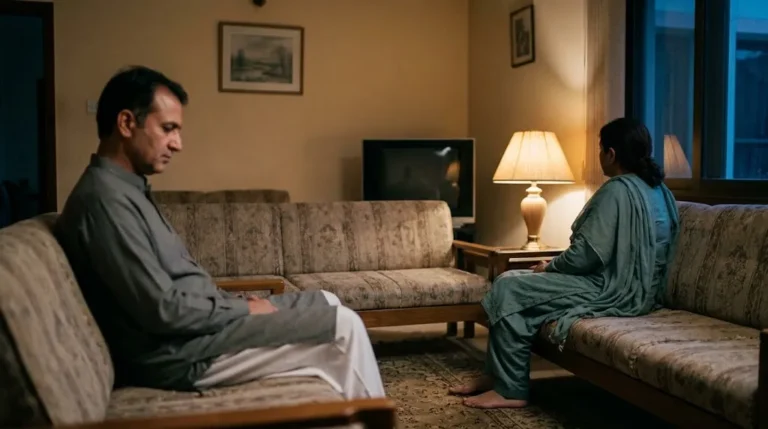
The other partner feels attacked and does the sensible thing under attack: goes quiet, defends, or leaves the room. They are trying to stop the fight.
To the first partner, that withdrawal is far worse than the argument. It reads as not caring. So they escalate, because escalating is the only thing that has ever produced a response.
Which makes the second partner withdraw further. And so on, for years.
The thing to notice is that both people are doing something reasonable. She raises it because silence has not worked. He withdraws because engaging has always gone badly. Each response is a sensible answer to the other’s behaviour, and together they produce something neither of them wants.
Why the subject does not matter
The fight about the phone and the fight about his mother and the fight about the guest room are the same fight. You can settle any one of them and the next will arrive within a fortnight, because the subject was never the cause.
This is why couples who reach agreements never feel any better afterwards. They have negotiated the content of an argument whose content was incidental.
What it is usually actually about
Under almost every repeating fight sits one of a very short list of questions:
- Do I matter to you? The fight about the phone at dinner.
- Am I on my own in this? The fight about housework, or about money.
- Whose side are you on? The fight about his family, which is the most common version in Pakistani marriages by some distance.
- Can I trust you? Which may be about an actual betrayal, or about a hundred small things not followed through.
- Am I allowed to be myself here? The fight about her working, her friends, his time with his own family.
Those questions do not get asked directly, because asking them makes you vulnerable and years of unsuccessful arguing has taught both people that vulnerability is unwise. So they get asked through the guest room.
Four things that change it
Name the pattern, not the person
“We are doing the thing again” is a different sentence from “you always do this”. The first puts the pattern outside both of you, where it can be looked at. The second puts one of you on trial. Agreeing on a phrase in advance, when you are not fighting, is one of the few interventions couples can genuinely do by themselves.
Stop at the twenty-minute mark
Beyond about twenty minutes of heated argument, most people are physiologically flooded: heart rate up, thinking narrowed, no capacity left for hearing anything. Nothing useful has ever been said in hour three of a fight at midnight.
The pause only works if it has two parts. A time to stop, and a time to resume that is actually honoured. A break without a return is just withdrawal, and it confirms the pursuing partner’s worst reading.
The withdrawing partner has to say something before leaving
Not stay. Just say. “I cannot do this right now and I am not walking away from you. I will come back at nine.” Silence is heard as abandonment, and one sentence changes what the exit means entirely.
The pursuing partner has to open differently
The first sixty seconds predict the whole argument with unusual reliability. “You never” and “you always” produce defence every time, because they are statements about character rather than about an event.
One incident, one feeling, one request. “When you took the call during dinner I felt like I was talking to nobody. Can we keep phones off at the table.” It feels smaller and it is far harder to defend against.
What does not work
Deciding who is right. Every couple that has ever tried to settle a marriage by establishing the facts of an argument from three weeks ago has discovered that the winner does not feel any better.
Involving the families. It converts a private difficulty into a public one with permanent alliances attached, and it is extremely difficult to reverse.
Waiting for the other person to change first. Which is the most common strategy and the reason patterns run for a decade.
When to get help with it
When you can predict the entire argument in advance and have it anyway. When you have stopped raising things because it is not worth the night that follows. When one of you has started arranging life so as to be in the house less.
Marriage counseling is a 90-minute session with both partners, and the first job is usually mapping this pattern so both people can see it from outside. A great many couples find that the pattern, once visible, is far less personal than it felt.
If your partner will not attend, that is common and it is covered in what to do when your partner refuses counseling. Attending alone at the individual rate is a legitimate option and changes more than people expect, because a pattern needs two people to run and only one to interrupt.
Common questions
Why do we keep having the same argument about different things?
Because the subject is not the cause. Most repeating arguments are a single pattern, usually one partner pursuing and the other withdrawing, attached to whatever topic is available that week. Resolving the topic does not touch the pattern.
Is it normal for couples to argue often?
Frequency matters less than what happens during and after. Couples who argue regularly but repair afterwards do well. Couples who argue rarely because one of them has given up raising anything are usually in more difficulty.
What is stonewalling and why does it make things worse?
Stonewalling is shutting down and withdrawing during conflict, usually to stop it escalating. It reads to the other partner as indifference, which drives them to escalate further, so the behaviour intended to calm the situation reliably inflames it.
Should we go to marriage counseling or individual counseling?
If the difficulty is between you, a joint session shows the pattern in the room and is usually more effective. If one partner will not attend, individual counseling still works, because interrupting your own half of a pattern changes it.
How long is a marriage counseling session?
Ninety minutes, because two people need more room than one. Sessions are held over WhatsApp, Google Meet or Zoom, and both partners can join from different locations if needed.
Does it help to have family members mediate?
Rarely, and it usually makes things harder. It turns a private difficulty into a public one and creates alliances that persist long after the original argument is forgotten.
Ten minutes is enough to find out whether this helps.
What the research says
- A review of a decade of research found couple therapy helped around 70% of couples who received it, with results comparable to individual therapy. [1]
- Most people feel angry sometimes. NHS guidance suggests pausing before reacting and talking to someone outside the situation, and recommends professional help when anger is affecting your life or relationships. [2]
Sources
- Lebow JL, Chambers AL, Christensen A, Johnson SM. Research on the treatment of couple distress. Journal of Marital and Family Therapy, 2012. europepmc.org
- NHS. Get help with anger (reviewed 4 August 2026). www.nhs.uk
Last reviewed 29 September 2026. General information, not a diagnosis. In an emergency call Rescue 1122 or Umang’s 24-hour helpline on 0311 7786264. All helplines in Pakistan.