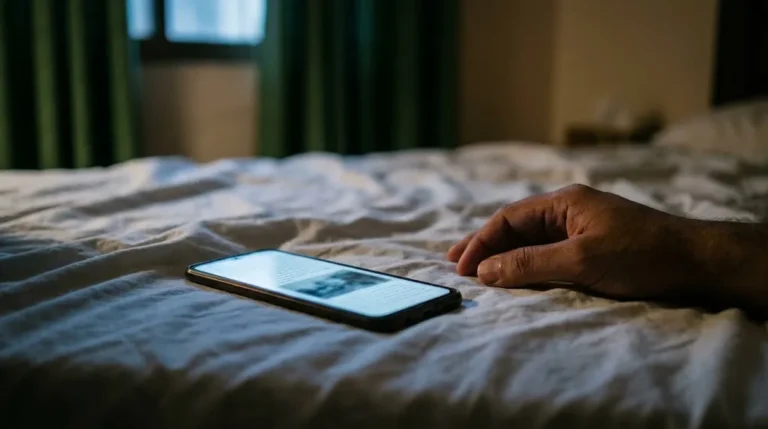
Waking at three in the morning with your heart racing
Short answer
Waking suddenly at night with a racing heart, tight chest and a sense of dread is usually a nocturnal panic attack. It is frightening but not dangerous, it typically peaks within ten minutes, and it happens at that hour because the body’s stress response is not suppressed by the daytime distractions that normally mask it.
It follows the same pattern for almost everyone who describes it. You are asleep. Then you are completely awake, sitting up, heart going hard enough to feel in your throat, certain that something is badly wrong. There was no dream. Nothing woke you. Within twenty minutes you are fine, and lying in the dark wondering what that was.
This is a nocturnal panic attack, and it is more common than most people realise, partly because almost nobody mentions it.
Why three in the morning
The hour is not a coincidence. A few things line up in the early morning:
- Sleep is lighter in the second half of the night, so you are easier to wake.
- Cortisol, the body’s main stress hormone, begins climbing in the hours before waking. It is supposed to. It is what gets you out of bed.
- There is nothing to look at, nobody to talk to and nothing to do, so there is no competition for your attention. A physical sensation that would go unnoticed at two in the afternoon has the whole stage at three in the morning.
Then the loop closes. You notice your heart. Noticing it frightens you. Fear raises your heart rate. The evidence gets stronger, so the fear does too. That loop, not any underlying danger, is what a panic attack largely is.
What it is not
It is not a heart attack, though it does an extremely convincing impression of one, and a large number of people end up in emergency rooms at two in the morning finding this out. It is worth saying clearly: if you have chest pain you have not had before, pain going into your arm or jaw, or you have any cardiac history, get it checked. Do that first. Do not read an article and decide.
Once a doctor has told you your heart is fine, believe them. A great deal of unnecessary suffering comes from people who have been cleared three times and are still quietly convinced they were missed.
What to do while it is happening
The instinct is to fight it, and fighting it feeds it. The aim is not to stop it. The aim is to stop adding to it.
Do not sit up and check things
Taking your own pulse, opening your phone to search symptoms, or waking someone to ask if you look alright all do the same thing: they confirm to your body that there is an emergency worth mobilising for.
Breathe out longer than you breathe in
Not deep breathing, which often makes it worse. In for four, out for seven or eight, as slow as you can manage without forcing it. The long out-breath is the part that matters, because it is the part that engages the system that slows the heart. Ten cycles.
Name it out loud, quietly
“This is panic. It peaks and it passes.” Said aloud, even in a whisper. It sounds too simple to do anything. What it actually does is move you from being inside the experience to describing it, and those are different mental positions.
Put your feet on the floor
Cold floor if possible. Then name four things you can hear. The point is not distraction, it is giving your attention something external to hold while the wave passes.
Let it be boring
The most effective long-term response is the least satisfying one: treat it as unremarkable. Panic thrives on being treated as an emergency. People who recover fastest tend to be the ones who got to the point of thinking “oh, this again” and going back to sleep.
Afterwards, and the second night
The night after the first one is often worse, because now you are going to bed watching for it. That watchfulness is itself a stress response, and it makes waking more likely, which confirms the fear. This is where a single bad night turns into a pattern, and it is the point at which it is worth getting help rather than waiting.
Practical things that genuinely reduce frequency: caffeine before mid-afternoon only, alcohol not at all if this is happening, a consistent wake time even after a bad night, and not lying in bed awake for more than about twenty minutes. Get up, sit somewhere dim, go back when you are sleepy.
When to get help with it
If it has happened more than a few times, if you have started dreading bedtime, or if you are arranging your day around being tired, it has stopped being an isolated event. Anxiety counseling works well on this particular pattern, because the loop that drives it is visible and can be interrupted once you can see it.
If you are not sure it is worth a session, a free ten-minute call is enough to describe what has been happening and find out.
If you have thoughts of harming yourself, this is not the right kind of help and it is not the right speed. Contact emergency services or go to a hospital now.
Common questions
Can a panic attack wake you from sleep?
Yes. Nocturnal panic attacks begin during sleep and wake you already in full physical alarm, with no dream and no obvious trigger. They are common and are not a sign that something is medically wrong with your heart.
How long does a night-time panic attack last?
The physical peak is usually under ten minutes, though the shakiness and the alertness afterwards can last an hour or more and often make it feel much longer.
How do I know it is panic and not a heart problem?
You do not, from an article. Chest pain that is new to you, pain spreading to the arm or jaw, or any cardiac history should be assessed by a doctor first. Once your heart has been checked and cleared, repeated episodes with this pattern are very likely to be panic.
Why does it always happen around the same time?
Sleep is lighter in the second half of the night and cortisol rises naturally before waking. Combined with a dark, silent room that offers nothing else to attend to, the early morning hours are when the body’s alarm is easiest to notice and hardest to ignore.
Should I wake my spouse when it happens?
It is understandable and it is not harmful occasionally. As a routine it tends to reinforce the sense that an emergency is under way, which makes future episodes more likely.
Does counseling actually help with night-time panic?
Yes, and it is one of the patterns that responds most reliably, because the cycle that sustains it is identifiable and can be broken once you can see it happening.
Ten minutes is enough to find out whether this helps.
What the research says
- Anxiety disorders are the most common mental health conditions worldwide. The World Health Organization estimates 470 million people had one in 2023. [1]
- The WHO defines stress as a state of worry or mental tension caused by a difficult situation, and lists a daily routine, enough sleep and staying connected to trusted people among the first things that help. [2]
Sources
- World Health Organization. Anxiety disorders, fact sheet (updated 15 September 2026). www.who.int
- World Health Organization. Stress, questions and answers (30 March 2026). www.who.int
Last reviewed 29 September 2026. General information, not a diagnosis. In an emergency call Rescue 1122 or Umang’s 24-hour helpline on 0311 7786264. All helplines in Pakistan.