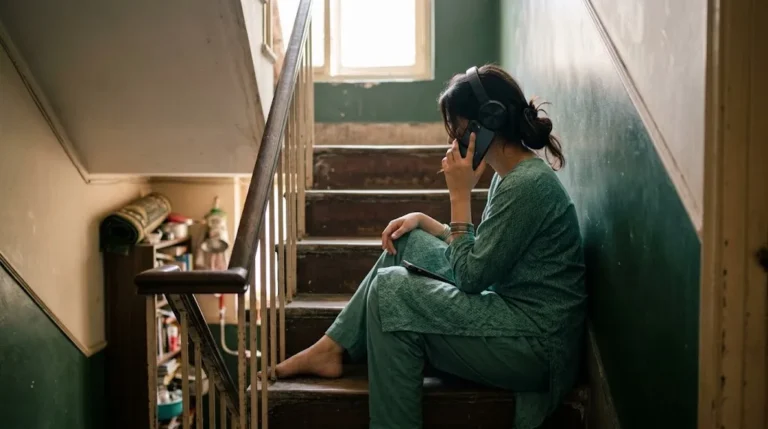
What to do when counseling does not seem to be working

Short answer
Say so, in the session. Most of the time counseling that feels stuck is either aimed at the wrong problem or moving at a pace that has not been discussed, and both are fixable once named. If you have raised it clearly and nothing changes over the next two or three sessions, it is reasonable to change counselor.
This is an uncomfortable article to write on a counseling website, and it is the honest one. Not every course of counseling works, not every counselor suits every person, and the people most likely to quietly disappear are the ones who feel it is not helping and cannot think how to say so.
First, what “working” usually looks like
Almost nobody leaves a session feeling resolved. The change, when it comes, tends to arrive in the ordinary week rather than in the hour, and it is usually smaller and more boring than expected:
- You notice the argument starting before you are already in it.
- You are upset for an evening instead of four days.
- You say the actual thing instead of the safer version of it.
- Something that was unsayable becomes sayable, even if nothing else has changed.
If you are measuring against feeling better, you may miss these entirely. Feeling better often comes later, and sometimes things feel worse for a while first, particularly if you have started talking about something you had been carefully not thinking about.
The three reasons it usually stalls
1. You are working on the presenting problem, not the real one
People often arrive with the manageable version. Someone books about work stress and the actual difficulty is a marriage. Someone books about their child and the actual difficulty is their own exhaustion. This is not dishonesty, it is how people approach a stranger.
If four sessions have been thorough, sensible and useless, this is the most likely reason, and the fix is a single sentence: “I think what I actually want to talk about is something else.”
2. The pace is wrong for you
Some people need to be asked directly and find open-ended sessions frustrating. Others need to circle a subject for weeks before approaching it and feel pushed by direct questions. Pace is adjustable, and it is rarely adjusted because it is rarely mentioned.
3. It is the wrong kind of help
Counseling is not the answer to everything, and a good practitioner will say so. If you cannot sleep, cannot eat, cannot work, or the low mood has a physical quality that talking does not touch, a psychiatrist may need to be involved, because medication is not something a psychologist can prescribe. The difference between the two is set out on the page about psychologist or psychiatrist. Being referred on is not a failure of the counseling; it is the counseling doing its job.
How to raise it
Directly, at the start of a session rather than the end, so there is time to do something with it. Any of these work:
- “I want to say something. I do not feel like this is going anywhere and I do not know if that is me.”
- “We have talked about this for a month and I still leave feeling the same.”
- “I think I have been avoiding the actual thing.”
A counselor who takes this badly has told you something useful. One who takes it seriously will usually change something in that same session.
How long to give it
There is no rule that fits everyone, and anyone who gives you a precise number is guessing. As a working guide: raise it as soon as you feel it, and give it two or three sessions after you have raised it. If nothing has shifted in approach, in focus, or in how the hour feels, that is enough information.
Leaving is allowed. You do not owe a counselor a course of sessions, and you are not required to explain yourself on the way out.
Before you decide it is not working, check these
- Frequency. Sessions a month apart often cannot build anything, because each one is spent catching up. Weekly or fortnightly is where most of the work happens.
- The week between. If nothing you discuss ever gets tried outside the hour, the hour is doing all the work alone.
- Whether you are telling the truth in it. Plenty of people spend sessions giving a managed account of themselves. It is entirely human and it does stall the process.
- Whether you actually want to change the thing. Sometimes the honest answer is no, and saying that out loud is more productive than months of circling it.
If money is the reason you are wondering
That is a legitimate reason and worth saying plainly rather than quietly stopping. Session frequency can be reduced, text chat costs less than calls, and the fees and packages page sets out every option, including packages that lower the per-session cost. Unused sessions in a package can be refunded, so nothing is trapped.
A note on changing counselor
Fit matters more in this work than in most, and there is no insult in it. Some people need a warmer style; some need a blunter one. If you move on, take what you learned about what did not suit you, because that is the most useful thing you can bring to the next one.
Common questions
How many sessions before counseling should start helping?
Many people notice something small within three or four sessions, but it varies a great deal with what is being worked on. What matters more than a number is whether anything is changing in the ordinary week, and whether the focus feels right.
Is it rude to tell my counselor it is not working?
No, and it is one of the most useful things you can say. It usually changes the direction of the work immediately. A counselor who reacts badly to it has answered a different and more important question for you.
Can I change counselor without explaining why?
Yes. You are not required to give a reason, and you are not obliged to complete a course of sessions.
What if I feel worse after starting counseling?
Feeling worse for a short period is common when you begin talking about something you have been avoiding. It should be temporary and it should be discussed in the session. If it is persistent or severe, say so immediately.
Can I get a refund on sessions I have not used?
Yes. Unused sessions in a package can be refunded. A session that has already been taken cannot. The terms page sets this out in full.
What if counseling is not the right kind of help for me?
Then it should be said. Some difficulties need a psychiatrist, medication, or medical investigation, and a counselor who recognises that and says so is doing the job properly.
Ten minutes is enough to find out whether this helps.
What the research says
- Talking therapies involve speaking with a trained professional about your thoughts, feelings and behaviour, and are used for a wide range of difficulties. [1]
- Talking treatments such as behavioural activation, cognitive behavioural therapy, interpersonal psychotherapy and problem-solving therapy are recognised as effective for depression. [2]
Sources
- NHS. Talking therapies (reviewed 5 November 2025). www.nhs.uk
- World Health Organization. Depressive disorder (depression), fact sheet (updated 11 September 2026). www.who.int
Last reviewed 29 September 2026. General information, not a diagnosis. In an emergency call Rescue 1122 or Umang’s 24-hour helpline on 0311 7786264. All helplines in Pakistan.